


How Does the Neck Lift Procedure Work?

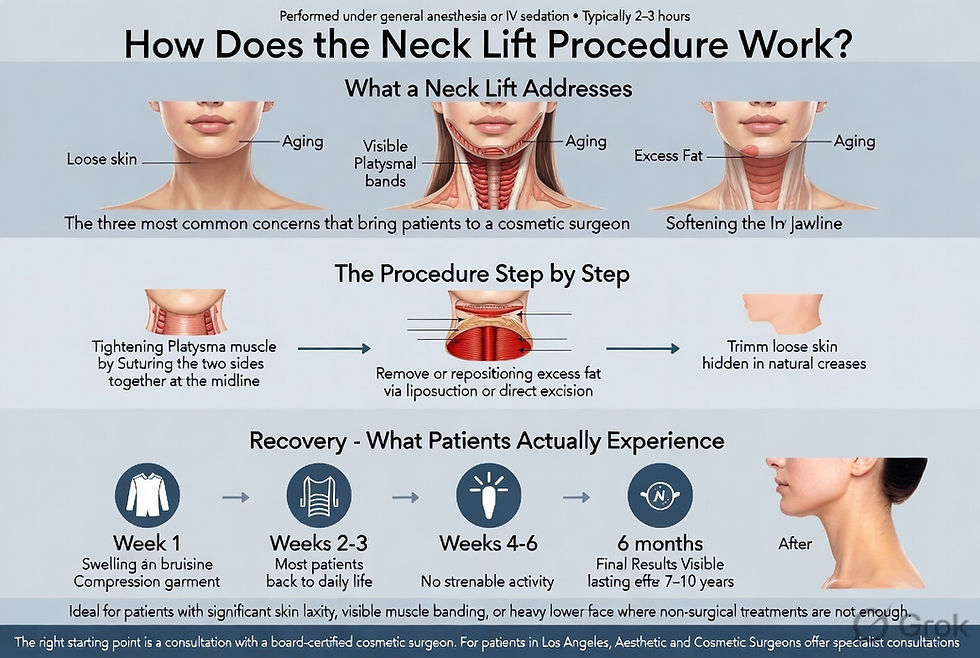
Most people researching a neck lift want a straightforward answer to one question: what actually happens during the procedure, and what it can realistically do. Here is an honest account of how it works from consultation to recovery.
What a Neck Lift Addresses
The neck is one of the first areas of the face and body to show the signs of ageing, and it is often the last thing people think to address. Loose skin along the jaw and upper neck, visible platysmal bands — the vertical muscle cords that appear under the chin — and fat deposits that soften what used to be a defined jawline are the three most common concerns that bring patients to a cosmetic surgeon.
A neck lift, medically called a platysmaplasty or lower rhytidectomy, depending on the specific technique, surgically addresses all three. It tightens the underlying muscle, removes or repositions excess fat, and removes the loose skin that no injectable or non-surgical treatment can fully correct at a structural level.
The Procedure Step by Step
A neck lift surgery is performed under general anaesthesia or intravenous sedation, depending on the extent of the work and the surgeon's recommendation. The procedure typically takes between two and three hours.
Small incisions are made behind each ear and sometimes under the chin, depending on what needs to be addressed. Through these incisions, the cosmetic surgeon accesses the platysma muscle (the broad, flat muscle running down the neck) and tightens it by suturing the two sides of the muscle together at the midline. This step eliminates the visible banding under the chin and creates a smoother, tighter neck contour.
Excess fat is removed either through liposuction or direct excision, depending on its location and volume. Loose skin is then trimmed, and the incisions are closed. The incisions behind the ears sit in natural creases where scarring becomes largely invisible once healed.
Recovery — What Patients Actually Experience
The first week involves swelling, bruising around the neck and jaw, and tightness that patients often describe as feeling like a very firm pressure rather than outright pain. A compression garment is worn around the neck during this period to support the healing tissue and reduce swelling. Most patients manage comfortably on standard pain relief prescribed by the cosmetic surgeon.
By the two to three week mark, most patients are back in daily life without anyone around them noticing anything obvious. The compression garment is typically worn for a shorter period during the day by this point. Strenuous activity and anything that significantly raises the heart rate are restricted for about 4 to 6 weeks.
The final result takes several months to fully appear, as residual swelling gradually resolves. Most patients see the complete outcome at around the six-month mark, and the results, once the underlying muscle has been tightened and the excess skin removed, are long-lasting. Most patients can expect their results to last 7 to 10 years, depending on how their skin ages.
Who It Works Best For
A neck lift produces results that non-surgical alternatives cannot replicate for patients with significant skin laxity, visible muscle banding, or a heavy or undefined lower face. Patients who have tried thread lifts, injectables, or skin-tightening treatments and felt the results were not sufficient are often the strongest candidates for surgery.
The right starting point is a consultation with a board-certified cosmetic surgeon who specialises in facial procedures, can assess individual anatomy, discuss realistic outcomes, and provide an honest picture of what the procedure entails.
For patients in Los Angeles considering a neck lift, Aesthetic and Cosmetic Surgeons offer specialist consultations with board-certified cosmetic surgeons experienced in neck lift procedures.


Comments